
Get in the DIRT: Notes on Leadership
By Mark Howell
I was fulfilling my duties as Chair of the Missouri Prescribed Fire Council in attending a Prescribed Burn Association interest meeting the other day, and I said something that’s probably been said in some form before (likely by Jocko) - but I don’t think this particular audience had heard it before:
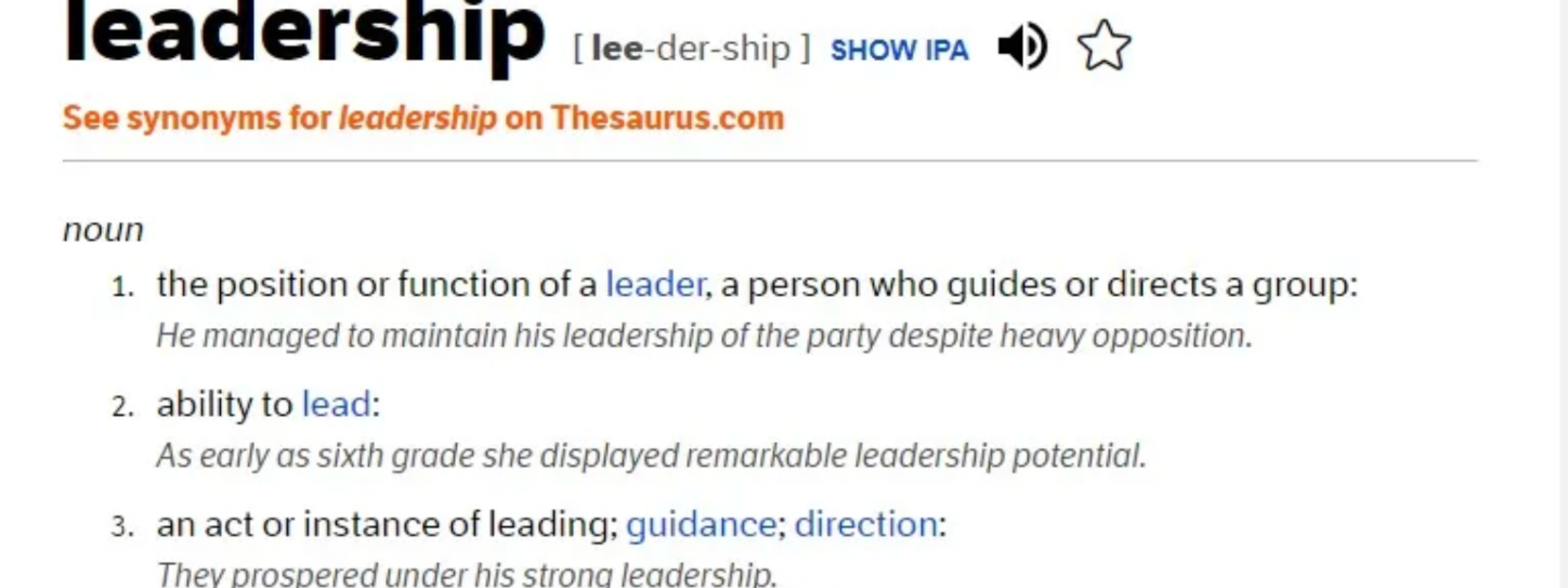
“Leadership” isn’t a position or title, it’s not a noun - it’s an action, a verb.
To clarify the caption:
-
Having a position means nothing if you do nothing with it. Plenty of people obtain and utilize positions of “leadership” for their own personal fame, gain, and to achieve their own ends often with negative consequences and outcomes for the organization/group. Are you going to argue that that’s “leadership”?
-
Again, ability is awesome, and potential powerful, but they mean nothing if you don’t use them. At that point, it’s better defined as “personal magnetism”, “charisma”, “charm”, etc.
-
The only definition that matters.
-
See 1 above.
Maybe Colossus is right that it only takes “four or five moments” to be a hero. I wouldn’t know; I’m not and never have been a “hero”.
Being a leader doesn’t take every moment - for example, you don’t “brush your teeth a leader” - but it takes a lot more moments than just four or five. It also takes some principles and values, and that’s what I’d like to explore with you today.
Enter the Wildland Fire Service
During my childhood, I was in Boy Scouts and Sea Cadets through my teens, early 20s in Civil Air Patrol, later 20s-late 30s in the California State Guard (yes, that’s a real thing). Every one of those organizations had at least one Creed and Guiding Principles for Leadership, etc. - most of them pretty lengthy and not very “user-friendly”. If you can’t remember it, or need a dictionary to understand it, it’s not very usable or practical, right?
It wasn’t until I joined the Wildland Fire Service that I learned a practical, usable framework for leadership. It had three simple tenets: Duty, Respect, Integrity. In light of our modern times and proclivities of the upper echelons of government and business, (for a quick, generic contrast: “leadership” is an action, “management” is inaction), I add Transparency.
DIRT - it’s both a cool initialism and what wildland firefighters generally work in. Let’s explore what it means to get in the DIRT!
Duty
Duty applies anywhere you have made a commitment: work, kids, school, spouse, that little league team you signed up to coach this summer. For most people “duty” evokes Soldiers standing guard at the Tomb of the Unknowns, or their FOB; Firefighters on the line, etc. Few would regard coaching a little league team, or any number of other regular commitments as a duty - and that, my friends, is part of the problem.
It is an obligation you take, that binds you to others through shared experience and mutual sacrifice. “Wait you’re saying showing up to work/coaching little league is a sacrifice?”
Yeah, I am - you could call in sick, stay home, and play Call of Duty all day - but there’s work to be done and skills you provide that, without you, the team falters.
Taking on those commitments is a big step. Recognizing the ties that those commitments represent and honoring them to the fullest - that’s the essence of Duty. It doesn’t matter if you’re a Junior Burger Flipper at Mom & Pop’s Burger Shop, or Mom & Pop themselves - the things you can do to fulfill your Duty are:
-
Know your role in the team - inside-out, backwards, forwards, and sideways.
-
Make sound decisions that promote the good of the organization.
-
Learn the next role up.
-
Mentor the next role down.
Integrity
Oh boy, this one is glaringly obvious. Read or watch the news, any news of any particular leaning, on any particular day, and the failures in this tenet jump out like an arterial bleed:
“POLITICIAN ROCKED BY SCANDAL!”
“CEO UNDER INDICTMENT!”
“[BIG COMPANY] ACCUSED OF [BAD THING]!”
It’s so pervasive and continuous as to not even be “news” anymore. The Integrity failures, major ones! are everywhere and blasted 24/7 for all to see, hear, and read about.
Even when the lambasted Corporate Crony/Political Patsy takes to Twitter X to recite the standard-issue “heartfelt acknowledgement, apology, and resignation tweet” (if there’s a new term for “tweet” with the brand change, I’m unaware of it and - Transparency! - really don’t care), the obfuscated reality is that they’re likely being handed a generous severance package, or ushered off to a newer, quieter, but almost as lucrative position elsewhere.
That’s a small part of what spurred me to add “Transparency” to this list, we’ll go into that more later.
When I was a kid, Integrity was defined as “Doing the right thing even when no one is looking.” Now, thanks to cell phones, cameras, and internet everywhere (you could get cell service in the Kings Canyon backcountry when I left California 7 years ago - it’s probably all 5G up to the peak of Mt Whitney by now), everyone is looking, all the time, and we still can’t seem to do the right things, or even manage a hint of consistency!
If you want a great example of Integrity, take Jocko’s Extreme Ownership, read it, and do it, but not too extremely, or we’ll have to whack you with the Dichotomy of Leadership:
-
Hold yourself accountable for the actions and outcomes of the team, even if it’s “not your fault”.
-
Hold others accountable to conduct and performance standards - “Extreme Ownership” is not an “olly-olly-oxen-free” for subordinates OR superiors.
-
Choose a direction and seek improvement. Nobody is perfect.
-
Internal and external consistency - your thoughts, words, and deeds align - hopefully in an honest, honorable way.
Respect
Surprise! yet another critical item missing from everyday interaction in all walks and aspects of life! I’m not going to bemoan the lack of it in our daily and online interactions, I’m just going to say we need to improve and do better.
Again I’ll hang my hardhat on an old adage from my childhood, the Golden Rule: “Respect is treating others the way you want to be treated.” With the spot price of gold at almost $2000 per ounce at the time of this writing, you would think people would be all over it.
Nope.
Instead, there’s the infamous “Mushroom Treatment” - for those not in the know that’s “keep your people in the dark and shovel shit on them”. In more toxic work environments, it goes beyond that to manipulation and outright deceit. It seems some folks higher up the food chain either aren’t following the Golden Rule, or they are and have a psychological sadomasochistic streak.
A little illustration:
I’m on the HARO List - “Help A Reporter Out”, it’s a 3x daily emailed list of questions and asks for expert advice/insight from journalists and writers to bolster articles or books they’re working on. It seems like every other day there’s something in the Business & Finance section about “toxic work environments” - whether asking for horror stories or “how-to-fix” advice. Clearly there’s no issue with workplace toxicity anywhere, right? My “how-to-fix” advice is simple, like your big brother used to tell you when you got a cut or scrape in the yard: “Rub some DIRT on it. Then walk it off… and whatever you do, don’t tell mom.”
How do we exhibit Respect, besides treating others well and “being nice”? If you’re asking that, I’m not sure you’re picking up what I’m putting down here. I would argue that “being nice” may in fact be disrespectful, if you’re using that “niceness” to cover up an issue or problem, or using it falsely to manipulate someone.
In the leadership realm, Respect can be embodied in many different ways, but here are a few that spring immediately to my mind:
-
Learn to do Active Listening - practice it with peers, supervisors, subordinates, pretty much everybody! You’ll find it helps improve your relationships with and knowledge of virtually everyone you meet!
-
Get to know your people, actually know them (as much as professionally appropriate of course), particularly their strengths and weaknesses.
-
Give your people assignments and opportunities that let them showcase their strengths and mitigate their weaknesses.
-
Help them shore up weaknesses and improve them via mentoring and training.